Hello everyone and welcome to my blog for my work experience!

My name is Cameron Molloy and I am a second year on the Foundation Degree in Sports Coaching course at Runshaw/UCLAN. As part of this course, we are required to complete a 60 hour work experience in a occupation to which we would like to work towards in our professional career.
Due to my aspiration being to work towards a P.E. Teacher, I have decided to complete my work experience at my old high school, Wellfield High School. This is because I already know the existing teachers making me fit into my surrounds a lot quicker. This blog will account for my diary where I will blog around what I have done each day and reflect on what has occurred. My work experience will consist of working 1 full day every Wednesday until those 60 hours are complete. In Wellfield High School, I will look at covering all aspects of teaching including; (1) Practical sessions, (2) Theory sessions, (3) Planning P.E. lessons, (4) Marking work, and (5) After school activities. This as a whole will give me a clear insight of what I will be expected to do in the professional and whether or not I want to continue my path on becoming a P.E. teacher. Wellfield High School follow a specific motto to which their base their curriculum around, “Inspire – Challenge – Achieve – Nurture” (WHS, 2019). In addition, their school aim is to provide a broad and balanced curriculum which focuses on maximizing the students’ potential, to make students the best that they can become (WHS, 2019). The school began as a self-produced high school, however, in 2017, the school decided to join partnership with the Endeavour Learning Trust (WHS, 2019). This sparked a new beginning for Wellfield as they became partners with two other schools; Tarleton Academy and Burscough Priory (WHS, 2019).
Reflection Model
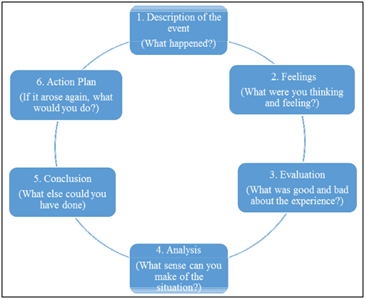
Within my work experience, I will be using Gibbs’ model of reflection (Gibbs, 1988) which is comprised of six distinct steps, namely: the description of what has happened; the feelings revolving around the experience; the analysis or sense making of the situation; the conclusions and potential alternatives in dealing with the situation, and; the action plan that you would set in place if it would arose again (Gibbs, 1988; Mahlanze, Sibiya & Govender, 2015). This model is a cycle meaning that once you are at the last stage [in this case the action plan] Gibbs (1988) suggests that you act on the plan set, to allow yourself to reflect again and ultimately better yourself. Gibbs’ Reflective Cycle is illustrated in Figure 1.
This model will be used myself for its simplicity and easy-to-follow steps to understand and develop personally through the experiences that I’ll will go through during my work experience. After using Gibbs’ framework, Wilding (2008), Chong (2009), and Fakude & Bruce (2003) recommended it to be useful for deep learning and practical applications of reflective practice.
References:
Chong, M. C. (2009). Is reflective practice a useful task for student nurses? Asian Nursing Research, 3(3), 111-120.
Fakude, L. P. & Bruce, J. C. (2003). Journaling: A quasi-experimental study of student nurses’ reflective learning ability. Curationis, 26(2), 49-55.
Gibbs, G. (1988). The reflective cycle. Oxford Polytechnic, 15(3), 271.
Mahlanze, H. T., Sibiya, M. N. & Govender, S. (2015) ‘Guided reflection: A valuable tool for improving undergraduate student nurses’ levels of reflection’, African Journal for Physical, Health Education, Recreation & Dance, pp. 396–408.
WHS. (2019). [ONLINE] Available at: http://www.whs.lancs.sch.uk/. [Accessed 13 November 2019].
Wilding, P.M. (2008). Reflective practice: A learning tool for student nurses. British Journal of Nursing, 17(11), 720.
 Cameron's Work Experience Blog